
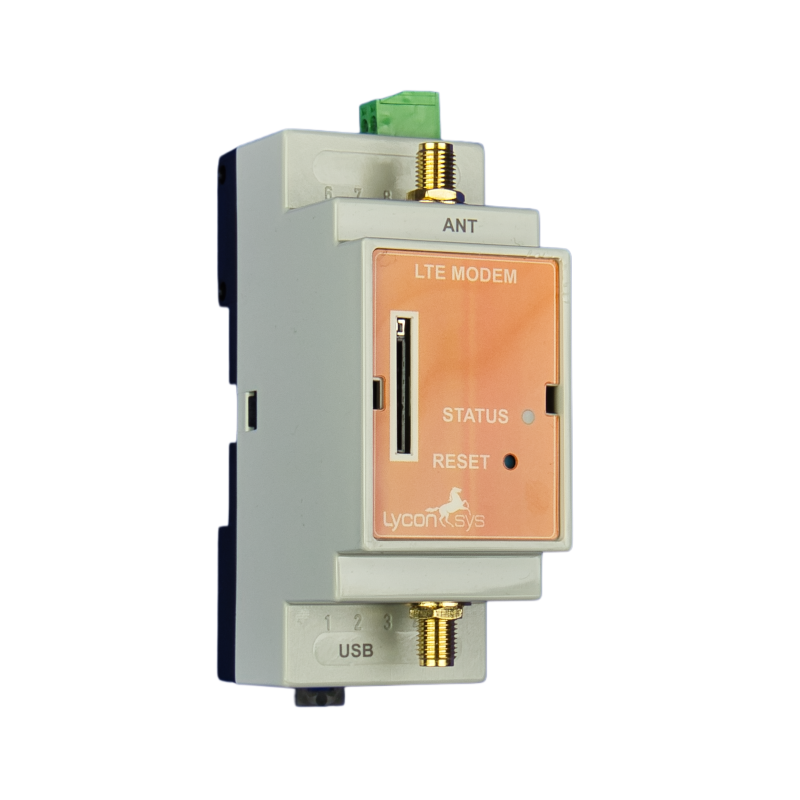
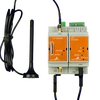
4G/LTE USB Modems
Highlights
- LTE Cat. 4 with up to 150 Mbps downlink and 50 Mbps uplink
- Automatic fallback to HSPA+, UMTS, EDGE and GPRS
- MIMO antenna technology via two external SMA connections
- Extended industrial temperature range from -30°C to +70°C
- Compact DIN-rail mounting, directly combinable with LyconSys VPN routers
- Two model variants for worldwide use
Our LTE modems enable fast cellular internet connections with up to 150 Mbps. Ideal for industrial PCs, VPN routers and embedded systems. Variants for Europe/Asia and global use available.
Our LTE modems enable fast cellular internet connections anywhere cable connection is not available. Connected via USB to a VPN router, industrial PC or Raspberry Pi, they provide a reliable solution for industrial data communication.
Technical Highlights
- LTE Cat. 4 with up to 150 Mbps downlink
- Automatic fallback to HSPA+/UMTS/EDGE/GPRS with weak LTE signal
- MIMO technology via two external SMA antenna connections for optimal reception
- USB interface for easy connection to routers, PCs and embedded systems
- Compact DIN-rail enclosure for control cabinet installation
- Two model variants for worldwide use
Model Variants
| Model | LTE Region | Typical Applications |
|---|---|---|
| 4G3LTE | Europe, Asia, South America, Africa | Germany, EU, China, India, Brazil |
| 4G4LTE | North America, Global | USA, Canada, Mexico, international projects |
Application Areas
- Remote maintenance and monitoring of machines and plants
- Cellular gateway for industrial PCs
- Backup connection for critical infrastructure
- Mobile and temporary installations
- IoT gateways with high data volume
- Together with LyconSys VPN routers as secure internet gateway
| Property | Value |
|---|---|
| Models | 4G3LTE, 4G4LTE |
| Chipset | Quectel EC25 |
| LTE Frequency Bands (4G3LTE) | B1/B3/B7/B8/B20/B28A and B38/B40/B41 - EMEA/Thailand |
| LTE Frequency Bands (4G4LTE) | B1/B2/B3/B4/B5/B7/B8/B12/B13/B18/B19/B20/B25/B26/B28 and B38/B39/B40/B41 - Global |
| HSPA+ Frequency Bands (4G3LTE) | B1 (2100), B2 (1900), B5 (850), B8 (900) |
| HSPA+ Frequency Bands (4G4LTE) | B1 (2100), B2 (1900), B4 (AWS), B5 (850), B8 (900) |
| Transmission Standards | LTE Cat. 4 (150/50 Mbps), DC-HSPA (42/5.76 Mbps), UMTS (384 kbps), EDGE (230 kbps), GPRS (85 kbps) |
| SMS | Send and receive |
| Data Interface | USB mini-B |
| Antenna Connections | 2× SMA(f) for MIMO |
| SIM Card Slot | Card slot with dust cover, compatible with 3.3V card types |
| Power Supply | 9 V to 24 V DC (max. 28 V), max. 5 W |
| Enclosure | DIN-rail enclosure (ABS) per DIN 43880 |
| Mounting | DIN rail (EN 50022), wall mounting (optional) |
| Protection | IP30 |
| Dimensions | 35 × 58 × 82 mm (W × H × D), 4 TE |
| Weight | 98 g |
| Operating Temperature | -30°C to +70°C |
| Humidity | 5% to 95% (non-condensing) |
| MTBF | 240,000 hours |
| Software Control | QMI, MBIM, Gobi API, standard and extended AT command set |
| USB Software Drivers | Windows 7/8/10/11, Linux, Android |
| Watchdogs | 2 hardware watchdogs, USB VBUS poweroff function |
| CE | EN 61000-6-2, EN 61000-6-4, EN 61000-4-2, EN 61000-4-3, EN 61000-4-4, EN 61000-4-6, EN 61000-4-29, EN 55022, EN 301 511, EN 301 908 |
| RoHS | EN 50581 |
- LTE modem
- USB connection cable (30 cm)
- Quick start guide
Your Benefits
Location-independent internet connection
Via USB directly to VPN router, industrial PC or Raspberry Pi – no fixed cable connection required.
High data transfer rates
LTE Cat. 4 with up to 150 Mbps downlink and MIMO antenna technology for optimal reception.
Reliable connection even in rural areas
Automatic fallback to HSPA+, UMTS, EDGE – no connection drop with weak LTE signal.
Easy installation via USB
Plug & play: standard drivers for Windows and Linux, no additional software package needed.
FAQ
Request now
Would you like more information or a quote?